Monday, December 04, 2006
Jacqui Woolley Featured for New Publication
Jacqui Woolley, a Michigan developmental psychology graduate student from the mid-late 1980s and a faculty member at the University of Texas, Austin ever since, just had a recent publication of hers featured in this news release by UT's media service. Congratulations to Jacqui!
Friday, November 17, 2006
Bo Schembechler, Legendary Football Coach, Dead at 77
Glenn E. "Bo" Schembechler, the University of Michigan football coach from 1969-1989, died today at age 77. In one of those bizarre coincidences, Schembechler's passing occurred just one day before the annual Michigan-Ohio State showdown. With the Buckeyes and Wolverines both sporting perfect records coming in -- and ranked No. 1 and No. 2 in the country, respectively -- some observers are calling tomorrow's game the most significant one of the long series between UM and OSU.
Cranky and "old school," but with a grandfatherly friendliness, Schembechler was -- and always will be -- a UM institution. As noted in the above-linked university tribute to him, Schembechler spoke at the 2005 Michigan commencement (a video is also available). I suspect there are not too many college coaches in any sport who would be invited to speak at a graduation some 15 years after their coaching days were over!
There's a Schembechler Hall on campus, and there was even a reference to him in the 1983 movie "The Big Chill" (see the item toward the bottom of this Big Chill trivia list).
The UM has lost one of its true icons, one who not only made things exciting for Wolverine football fans, but also really connected to the university community as a whole.
Cranky and "old school," but with a grandfatherly friendliness, Schembechler was -- and always will be -- a UM institution. As noted in the above-linked university tribute to him, Schembechler spoke at the 2005 Michigan commencement (a video is also available). I suspect there are not too many college coaches in any sport who would be invited to speak at a graduation some 15 years after their coaching days were over!
There's a Schembechler Hall on campus, and there was even a reference to him in the 1983 movie "The Big Chill" (see the item toward the bottom of this Big Chill trivia list).
The UM has lost one of its true icons, one who not only made things exciting for Wolverine football fans, but also really connected to the university community as a whole.
Tuesday, October 31, 2006
James Hilton Moves to UVA
In response to my recent Michigan-Princeton-Waterloo overlap analysis (immediately below the present posting), I received word that longtime UM professor (and Princeton Ph.D.) James Hilton had moved to another university in an information technology (IT) capacity. After a little bit of web searching, I see that he's now at the University of Virginia (news release).*
James joined the Michigan social psych faculty in the Fall 1985 semester (I'm virtually certain of the timing). I entered the graduate program in Fall 1984, and the faculty search/hiring process that yielded James was my first exposure to job talks, meetings with candidates, and other such events. James's research focused on person perception and self-fulfilling prophecies; during his first few years at UM, the graduate students with whom he primarily worked (based on a review of article references) included Steve Fein and Bill von Hippel.
As noted in the above-linked UVa news release, James also left a lasting impression with his teaching. The basic undergraduate social psychology lecture course had several hundred students, with students also attending discussion sections of around 25 for an hour a week. I was a Teaching Assistant for James one semester and, in addition to leading a couple of sections, I attended the lectures.
I would say that within the first 10 minutes of his first lecture of the semester, James had the students in the palm of his hand. His sense of humor -- sardonic, but not acerbic -- was very effective with the students.
For example, in setting the stage for his presentation on the classic social-psychological finding that people prefer to affiliate in anticipation of a stressful event rather than wait alone (see description of the Schachter study toward the bottom of this document), Hilton reminded the class of a common occurrence on exam days.
Almost invariably, it seems, students gather in the hallway before a test, to discuss material from their notes with other students. Why do students show up early? , James asked the class. Was it because they wanted to allow enough travel time in case they blew out a tennis shoe along the way? No, he insisted. It could well be because affiliation with others would help to alleviate the pre-test anxiety.
The UVa news release also mentions that James is returning to what sports fans would identify as "ACC Country," Virginia being close to Hilton's boyhood home of North Carolina. In another of his memorable classroom demonstrations, James once started lecturing in a heavy North Carolina accent, driving home the important person-perception point that the presence or absence of a Southern accent would likely lead people to judge him differently.
Best wishes to James as he begins this new phase of his career!
---
*Hilton returned to the University of Michigan in 2013 as Dean of Libraries.
[The information above about the size of the large lecture courses was edited slightly from an earlier version, for clarity.]
James joined the Michigan social psych faculty in the Fall 1985 semester (I'm virtually certain of the timing). I entered the graduate program in Fall 1984, and the faculty search/hiring process that yielded James was my first exposure to job talks, meetings with candidates, and other such events. James's research focused on person perception and self-fulfilling prophecies; during his first few years at UM, the graduate students with whom he primarily worked (based on a review of article references) included Steve Fein and Bill von Hippel.
As noted in the above-linked UVa news release, James also left a lasting impression with his teaching. The basic undergraduate social psychology lecture course had several hundred students, with students also attending discussion sections of around 25 for an hour a week. I was a Teaching Assistant for James one semester and, in addition to leading a couple of sections, I attended the lectures.
I would say that within the first 10 minutes of his first lecture of the semester, James had the students in the palm of his hand. His sense of humor -- sardonic, but not acerbic -- was very effective with the students.
For example, in setting the stage for his presentation on the classic social-psychological finding that people prefer to affiliate in anticipation of a stressful event rather than wait alone (see description of the Schachter study toward the bottom of this document), Hilton reminded the class of a common occurrence on exam days.
Almost invariably, it seems, students gather in the hallway before a test, to discuss material from their notes with other students. Why do students show up early? , James asked the class. Was it because they wanted to allow enough travel time in case they blew out a tennis shoe along the way? No, he insisted. It could well be because affiliation with others would help to alleviate the pre-test anxiety.
The UVa news release also mentions that James is returning to what sports fans would identify as "ACC Country," Virginia being close to Hilton's boyhood home of North Carolina. In another of his memorable classroom demonstrations, James once started lecturing in a heavy North Carolina accent, driving home the important person-perception point that the presence or absence of a Southern accent would likely lead people to judge him differently.
Best wishes to James as he begins this new phase of his career!
---
*Hilton returned to the University of Michigan in 2013 as Dean of Libraries.
[The information above about the size of the large lecture courses was edited slightly from an earlier version, for clarity.]
Monday, October 16, 2006
Social Psychologists Who Spent Time at Michigan and Princeton and/or Waterloo
It's been almost exactly a year since my last "overlap analysis," which was between Michigan and the University at Buffalo/State University of New York (see October 2005 archives). In an overlap analysis, of course, I list people who have official affiliations with both of the institutions in question, as students, post-doctoral fellows, and/or faculty members (I tend to exclude cases in which someone served only in a brief visiting position at one of the schools).
Each of my previous analyses has looked at UM in conjunction with one other school. In thinking about which school to examine next for overlap with Michigan, I considered Princeton University and the University of Waterloo. I quickly realized that there were some people who had ties to all three institutions -- Michigan, Princeton, and Waterloo -- in addition to the many who were associated with two of the three.
Variety is the spice of life, so for a little change of pace, I now present my first three-way overlap analysis. The various combinations are shown first via Venn diagram, with a more detailed list of the named individuals following [names updated 10/17/06 ].
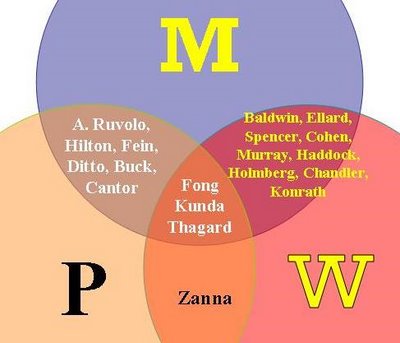
Michigan, Waterloo, and Princeton
(All three of the following individuals received graduate degrees from UM and had faculty/research positions at Princeton and Waterloo; see their respective webpages for further detail)
Geoff Fong
Ziva Kunda (deceased)
Paul Thagard
Michigan and Princeton
Steve Fein (Princeton undergraduate, UM Ph.D.)
Ann Ruvolo (Princeton undergraduate, UM Ph.D.)
Michelle Buck (UM undergraduate, Princeton Ph.D.)
Pete Ditto (Princeton Ph.D., UM post-doc)
James Hilton (Princeton Ph.D., UM faculty member; now at University of Virginia)
Nancy Cantor (Faculty and administration at both UM and Princeton)
Michigan and Waterloo
Diane Holmberg (Waterloo undergraduate, UM Ph.D.)
Sara Konrath (Waterloo undergraduate, current UM graduate student)
Jesse Chandler (Waterloo undergraduate, current UM graduate student)
Mark Baldwin (Waterloo Ph.D., UM post-doc)
John Ellard(Waterloo Ph.D., UM post-doc)
Sandra Murray (Waterloo Ph.D., UM post-doc)
Geoff Haddock (Waterloo Ph.D., UM post-doc)
Steve Spencer (UM Ph.D., Waterloo faculty)
Dov Cohen (UM Ph.D., Waterloo faculty; now at Illinois)
Waterloo and Princeton
Mark Zanna (Faculty at both)
Each of my previous analyses has looked at UM in conjunction with one other school. In thinking about which school to examine next for overlap with Michigan, I considered Princeton University and the University of Waterloo. I quickly realized that there were some people who had ties to all three institutions -- Michigan, Princeton, and Waterloo -- in addition to the many who were associated with two of the three.
Variety is the spice of life, so for a little change of pace, I now present my first three-way overlap analysis. The various combinations are shown first via Venn diagram, with a more detailed list of the named individuals following [names updated 10/17/06 ].

Michigan, Waterloo, and Princeton
(All three of the following individuals received graduate degrees from UM and had faculty/research positions at Princeton and Waterloo; see their respective webpages for further detail)
Geoff Fong
Ziva Kunda (deceased)
Paul Thagard
Michigan and Princeton
Steve Fein (Princeton undergraduate, UM Ph.D.)
Ann Ruvolo (Princeton undergraduate, UM Ph.D.)
Michelle Buck (UM undergraduate, Princeton Ph.D.)
Pete Ditto (Princeton Ph.D., UM post-doc)
James Hilton (Princeton Ph.D., UM faculty member; now at University of Virginia)
Nancy Cantor (Faculty and administration at both UM and Princeton)
Michigan and Waterloo
Diane Holmberg (Waterloo undergraduate, UM Ph.D.)
Sara Konrath (Waterloo undergraduate, current UM graduate student)
Jesse Chandler (Waterloo undergraduate, current UM graduate student)
Mark Baldwin (Waterloo Ph.D., UM post-doc)
John Ellard(Waterloo Ph.D., UM post-doc)
Sandra Murray (Waterloo Ph.D., UM post-doc)
Geoff Haddock (Waterloo Ph.D., UM post-doc)
Steve Spencer (UM Ph.D., Waterloo faculty)
Dov Cohen (UM Ph.D., Waterloo faculty; now at Illinois)
Waterloo and Princeton
Mark Zanna (Faculty at both)
Tuesday, August 15, 2006
Bob Josephs' Research Featured in APA Monitor
Bob Josephs, who received his Ph.D. in social psychology at Michigan in 1990, just had his research featured in the July-August issue of the APA's Monitor on Psychology. As described in this article, Bob's study showed a congruency between people's testosterone levels and their optimal functioning context (i.e., participants with high testosterone levels functioned better in a high- than low-status role, whereas those with low testosterone exhibited the reverse pattern).
Bob started graduate school at the University of Washington (which I recently visited and photographed) in the fall of 1984, where he worked with Claude Steele. When Claude moved to Michigan for the Fall 1987 semester, Bob came along. Initially during their time at UM, Claude and Bob finished writing up manuscripts on their "alcohol myopia" research. Bob then branched into additional areas, such as self-esteem and decision-making.
Based on the starting date of his graduate training (1984) rather than the start of his time at Michigan (1987), Bob was considered part of the same entering cohort with me and my classmates. Bob had three essential attributes -- he was a nice guy, an excellent and enthusiastic researcher, and a big sports fan -- and we became good friends.
Bob and I have both been based in the Lone Star State (and Big XII athletic conference), for many years, he at the University of Texas, Austin the entire time since completing his Ph.D., and me at Texas Tech for the last nine years. Given this proximity, we sometimes see each other at meetings of Social Psychologists in Texas (SPIT) and other organizations.
Probably my favorite grad-school story involving Bob stems from one of the aforementioned alcohol-myopia papers he was working on (which ultimately was published in 1990 in the Journal of Abnormal Psychology). Around this time (in August 1988), Sports Illustrated came out with a cover story on the role of beer in fan behavior, as seen on the right.
The SI piece actually made some conceptual points relevant to Bob's research paper, so he cited it. Then, a few months later, when he got the reviews back, Bob showed them to me. One of the referees had been taken aback by a citation to Sports Illustrated in a scholarly work! (I just checked the references for Bob's article, and the SI reference didn't make it into publication.)
Those were good times...
Bob started graduate school at the University of Washington (which I recently visited and photographed) in the fall of 1984, where he worked with Claude Steele. When Claude moved to Michigan for the Fall 1987 semester, Bob came along. Initially during their time at UM, Claude and Bob finished writing up manuscripts on their "alcohol myopia" research. Bob then branched into additional areas, such as self-esteem and decision-making.
Based on the starting date of his graduate training (1984) rather than the start of his time at Michigan (1987), Bob was considered part of the same entering cohort with me and my classmates. Bob had three essential attributes -- he was a nice guy, an excellent and enthusiastic researcher, and a big sports fan -- and we became good friends.
Bob and I have both been based in the Lone Star State (and Big XII athletic conference), for many years, he at the University of Texas, Austin the entire time since completing his Ph.D., and me at Texas Tech for the last nine years. Given this proximity, we sometimes see each other at meetings of Social Psychologists in Texas (SPIT) and other organizations.
Probably my favorite grad-school story involving Bob stems from one of the aforementioned alcohol-myopia papers he was working on (which ultimately was published in 1990 in the Journal of Abnormal Psychology). Around this time (in August 1988), Sports Illustrated came out with a cover story on the role of beer in fan behavior, as seen on the right.

The SI piece actually made some conceptual points relevant to Bob's research paper, so he cited it. Then, a few months later, when he got the reviews back, Bob showed them to me. One of the referees had been taken aback by a citation to Sports Illustrated in a scholarly work! (I just checked the references for Bob's article, and the SI reference didn't make it into publication.)
Those were good times...
Thursday, July 06, 2006
I've just returned from a trip to the West Coast that included a stop at the Society for the Psychological Study of Social Issues (SPSSI) conference in Long Beach, California. Below is a picture of me with Monica Biernat at our poster. As I describe below, our study's subject matter had to do with golf, and I spared no detail in trying to create a golf theme -- the poster itself was supposed to look like a golf course, I brought along a golf club, and all visitors to the poster were given a complimentary golf ball.
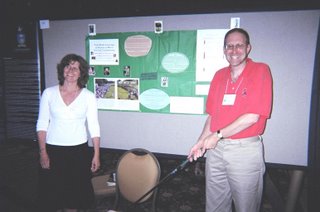
Monica and I were in the same entering cohort (Fall 1984) in the social psychology graduate program at Michigan, and we each finished in the summer of 1989. For the last 14 years, Monica has been on the faculty at the University of Kansas; two of her former KU graduate students, Kathy Fuegen and Terri Vescio, were also authors on the poster, but were unable to attend SPSSI.
One of the nice things about this poster is that it is the first collaboration between me and Monica in 15 years, using the official conference or article citation date (the previous one being: Reifman, A., Biernat, M., & Lang, E.L. [1991]. Stress, social support, and health in married professional women with small children. Psychology of Women Quarterly, 15, 431-445).
As I discussed a few months ago on this blog, Monica and I were both in Mel Manis's seminar on stereotyping in 1986. Monica has followed through in stereotyping and prejudice research since then, formulating the "shifting standards" model of social judgment (she has also recently come out with a book on the topic, one that would be good for a graduate seminar on social judgment).
I've gone in a few different research directions since grad school (primarily related to adolescent and young adult drinking), but I try to stay informed about the research being conducted by friends and colleagues of mine.
When female golfers Annika Sorenstam and Michelle Wie started playing in men's pro tournaments a few years ago, I came up with the idea of content analyzing media coverage of these women in men's tournaments, to test for evidence of shifting-standards phenomena. A detailed summary of the project, to this point, is available by clicking here.
Also while at SPSSI, I ran into another UM Ph.D. recipient from my era, Lisa Brown, on whom I can provide an update. After several years in Florida, Lisa is now on the faculty at Austin College, which is in Texas, but not in Austin (rather, it's in Sherman). Here's her faculty homepage, which is quite extensive.

Monica and I were in the same entering cohort (Fall 1984) in the social psychology graduate program at Michigan, and we each finished in the summer of 1989. For the last 14 years, Monica has been on the faculty at the University of Kansas; two of her former KU graduate students, Kathy Fuegen and Terri Vescio, were also authors on the poster, but were unable to attend SPSSI.
One of the nice things about this poster is that it is the first collaboration between me and Monica in 15 years, using the official conference or article citation date (the previous one being: Reifman, A., Biernat, M., & Lang, E.L. [1991]. Stress, social support, and health in married professional women with small children. Psychology of Women Quarterly, 15, 431-445).
As I discussed a few months ago on this blog, Monica and I were both in Mel Manis's seminar on stereotyping in 1986. Monica has followed through in stereotyping and prejudice research since then, formulating the "shifting standards" model of social judgment (she has also recently come out with a book on the topic, one that would be good for a graduate seminar on social judgment).
I've gone in a few different research directions since grad school (primarily related to adolescent and young adult drinking), but I try to stay informed about the research being conducted by friends and colleagues of mine.
When female golfers Annika Sorenstam and Michelle Wie started playing in men's pro tournaments a few years ago, I came up with the idea of content analyzing media coverage of these women in men's tournaments, to test for evidence of shifting-standards phenomena. A detailed summary of the project, to this point, is available by clicking here.
Also while at SPSSI, I ran into another UM Ph.D. recipient from my era, Lisa Brown, on whom I can provide an update. After several years in Florida, Lisa is now on the faculty at Austin College, which is in Texas, but not in Austin (rather, it's in Sherman). Here's her faculty homepage, which is quite extensive.
Tuesday, June 06, 2006
Jean Twenge, a San Diego State University faculty member who received her Ph.D. in personality psychology at the University of Michigan in 1998, recently came out with a book entitled, Generation Me: Why Today's Young Americans Are More Confident, Assertive, Entitled -- and More Miserable Than Ever Before (2006, Free Press).
Jean has developed a very successful line of research where, for whatever personality trait she happens to be studying at a given time (e.g., assertiveness or anxiety), she tracks down all available studies where the same questionnaire measure of the trait has been administered to college students, in articles published over the past three or four decades. With the measurement instrument and population (college students) held constant over time, she can thus uncover generational change in the traits she studies. The book reports the results of these investigations, non-technically for a general audience.
To glean all the needed research articles and reports, Jean has had to spend great amounts of time in libraries, which she writes about in a blended humorous-acerbic style. Much of her searching was, of course, done in the UM's Harlan Hatcher Graduate Library, which she describes as:
...a building so vast and confusing that red and yellow lines are painted on the stone floor to help people find the exits. The university had added on to the library in 1970, smushing two buildings of different styles and floor heights together with limited access between the two. The older building ended up with floors like "4A" ... connected by narrow, apparently randomly placed staircases.... (p. 13).
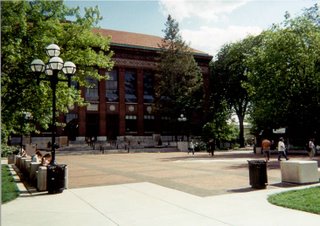
To the right is a picture I took of the graduate library during one of my visits to Ann Arbor in recent years.
Jean also writes, in places, with a feisty, earthy style, referring to one particular media report about marriage trends as "unmitigated crap" (p. 200).
Her research on today's young people meshes well with one of my own areas of research, the study of "Emerging Adulthood," a life stage in between adolescence and full-fledged adulthood. Beyond our somewhat overlapping research interests and receipt of Ph.D.'s from the University of Michigan (me almost a decade earlier), Jean and my career trajectories, in fact, have a number of parallels. While it's not exactly the Lincoln-Kennedy Coincidence, consider the following:
Jean grew up in Texas and is a faculty member at a university in California. I grew up in California and am a faculty member at a university in Texas.
Also, we each did post-docs in rustbelt industrial cities off of Lake Erie, Jean in Cleveland, and me in Buffalo.
And both of our first names have four letters, and end in "an"!
Jean has developed a very successful line of research where, for whatever personality trait she happens to be studying at a given time (e.g., assertiveness or anxiety), she tracks down all available studies where the same questionnaire measure of the trait has been administered to college students, in articles published over the past three or four decades. With the measurement instrument and population (college students) held constant over time, she can thus uncover generational change in the traits she studies. The book reports the results of these investigations, non-technically for a general audience.
To glean all the needed research articles and reports, Jean has had to spend great amounts of time in libraries, which she writes about in a blended humorous-acerbic style. Much of her searching was, of course, done in the UM's Harlan Hatcher Graduate Library, which she describes as:
...a building so vast and confusing that red and yellow lines are painted on the stone floor to help people find the exits. The university had added on to the library in 1970, smushing two buildings of different styles and floor heights together with limited access between the two. The older building ended up with floors like "4A" ... connected by narrow, apparently randomly placed staircases.... (p. 13).

To the right is a picture I took of the graduate library during one of my visits to Ann Arbor in recent years.
Jean also writes, in places, with a feisty, earthy style, referring to one particular media report about marriage trends as "unmitigated crap" (p. 200).
Her research on today's young people meshes well with one of my own areas of research, the study of "Emerging Adulthood," a life stage in between adolescence and full-fledged adulthood. Beyond our somewhat overlapping research interests and receipt of Ph.D.'s from the University of Michigan (me almost a decade earlier), Jean and my career trajectories, in fact, have a number of parallels. While it's not exactly the Lincoln-Kennedy Coincidence, consider the following:
Jean grew up in Texas and is a faculty member at a university in California. I grew up in California and am a faculty member at a university in Texas.
Also, we each did post-docs in rustbelt industrial cities off of Lake Erie, Jean in Cleveland, and me in Buffalo.
And both of our first names have four letters, and end in "an"!
Wednesday, April 12, 2006
The website that hosts this page (known as Blogspot or Blogger) has now made available the option to include photos in one's postings. As a result, I can now post some pictures I took during my visit to Ann Arbor last summer. Pictured below in clockwise fashion are: the Bell Tower, one of the major campus landmarks; the tower portion of the Michigan Union (student union); and the Psychology Building, which opened a few years after my cohort graduated.
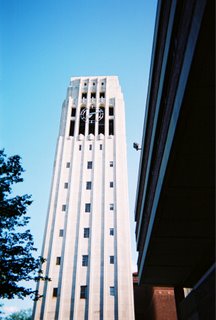

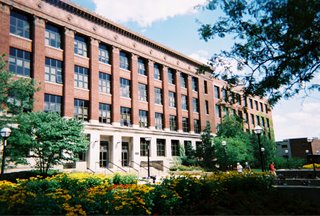
Now that I have this capability, I will continue to post additional pictures in upcoming entries.
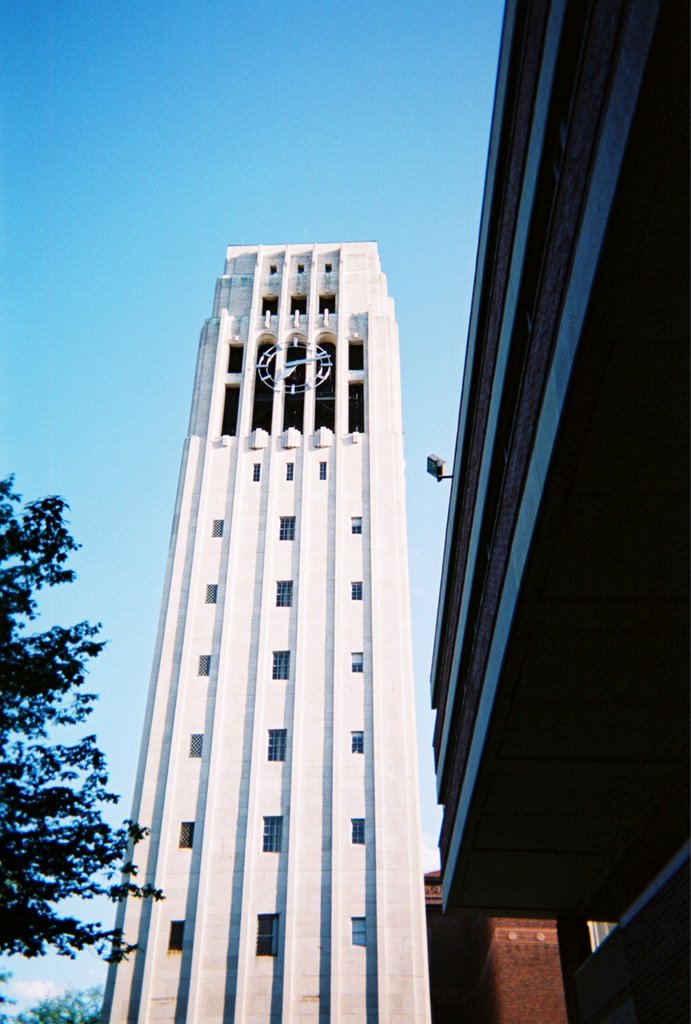
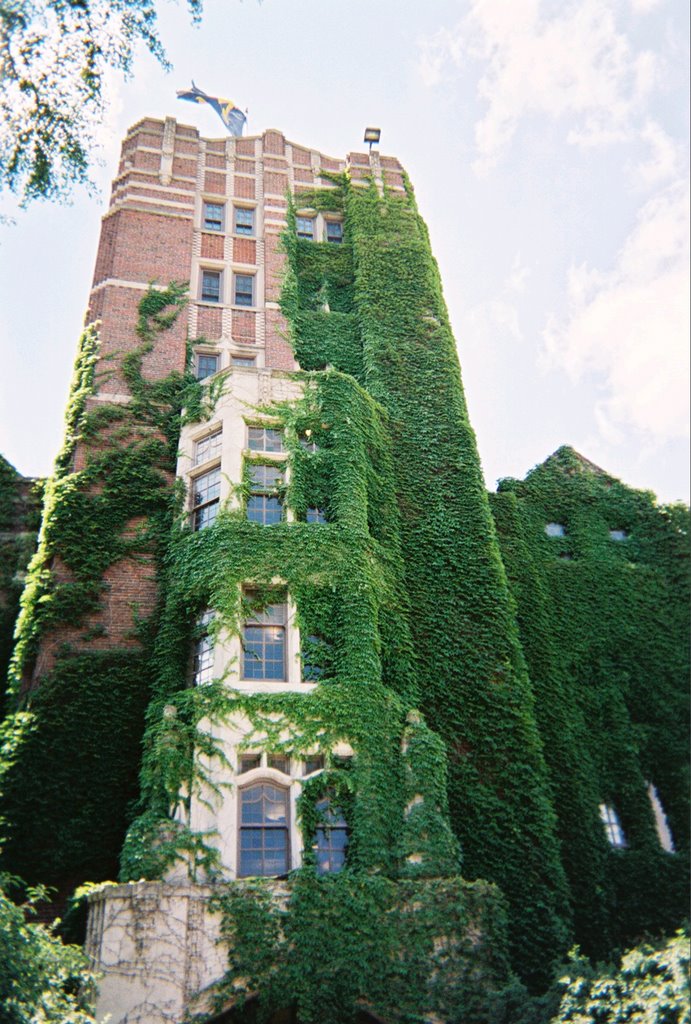
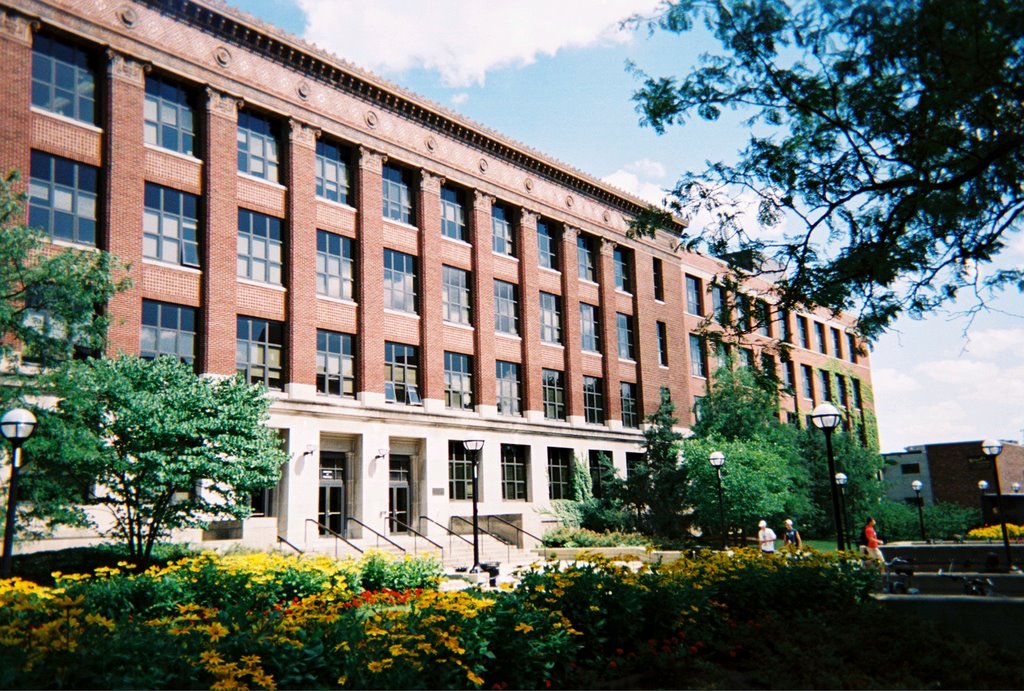
Now that I have this capability, I will continue to post additional pictures in upcoming entries.
Wednesday, March 29, 2006
It is now the 20th anniversary of Mel Manis's graduate seminar on stereotypes research, which was offered in the Winter 1986 semester (see Mel, now an emeritus professor, in this group photo of the UM social psych faculty). For this write-up, I shared my recollections of the seminar, in advance, with everyone whom I recalled being in it (including Mel), to see if my memories might trigger additional ones from them. I've now heard back from a few people, and am thus including their reflections in this essay.
A good starting point is to list who was in the seminar. Based on our best recollections, the following people were students in the class (with links to their current professional homepages, where available):
Monica Biernat
Lee Jussim
Janet Landman
Chris Langston
Linda Nyquist (a post-doc at the time)
Starting with Mel, our leader, he replied to my request for reflections with the following, very kind, statement:
My main memory about the stereotypes seminar was my pleasure in meeting with such a bright, interested group. One of the (many) pleasures of the academic life.
Monica and Lee each cited the seminar as an impetus to conducting research on stereotypes with Mel. Wrote Monica in a reply to my inquiry:
I'm afraid my memory is iffy other than that I really liked the course -- it made me want to work with Mel and got me doing stereotyping research. It's frightening to me that 20 years have passed!
Lee really was able to pinpoint specific aspects of the seminar that spurred certain directions in his research:
1. I think [Mel] had some required paper. I always hated doing papers for no reason. So, I asked him if he wanted to do a study. He, being the kind of guy he was, readily agreed, even tho we did not really have an idea.
So, we met and met and just talked. For months. And then it hit us -- all the cognitive business had forgotten affect! And we guessed that affect was at least as strong, maybe stronger than cognition, in its effects on judging individuals. So, that led to a series of studies titled "Prejudice vs. Stereotypes" as sources of labeling bias in person perception, which was eventually pubbed in JPSP. Not bad for a class.
[Note, the reference is: Jussim, L., Nelson, T.E., Manis, M., & Soffin, S.(1995). Prejudice, stereotypes, and labeling effects: Sources of bias in person perception. Journal of Personality and Social Psychology, 68, 228-246.]
2. It was in Mel's class that I first read McCauley, Stitt & Segal (1980). That paper seemed to me to be one of the most clear-headed things on stereotypes I had read up to that time. It has influenced my thinking about stereotypes in particular and expectancies in general, and was a major contributor to my thinking about accuracy.
[Reference: McCauley, C., Stitt, C., & Segal, M. (1980). Stereotyping: from prejudice to prediction. Psychological Bulletin, 87, 195-208.]
It partially inspired my '91 Psych Review, and it definitely led to my collaboration with McCauley on our '95 book. And it more than partially inspired me to go down the path that has led to the talk I am giving at EPA (they concocted the title out of thin air, the actual title is "The Unbearable Accuracy of Stereotypes").
[To see a summary of Lee's appearance at the 2006 Eastern Psychological Association conference, click here and then scroll down to the second page displayed.]
I, of course, have a few recollections of my own.
We read some chapters from Gordon Allport's The Nature of Prejudice, and I remember being amazed at the degree to which this book (from 1954) presaged the cognitive approach to stereotyping that became very popular in the 1980s.
David Letterman's show (then on NBC) was at a high point in popularity, and references to it permeated our seminar. For example, when writing article summaries to hand out, Janet would title them "Late Night Thoughts on..." Also, in discussing ways (hypothetically) to observe unobtrusively the degree to which kids at school interacted with kids of the other gender, other racial-ethnic groups, etc., the idea of using a "skycam" (a staple of Letterman shows) came up. According to this list of Letterman milestones, the skycam debuted on September 30, 1985, thus making it a salient novelty in early '86.
[Update 4/4/06: Janet sent me a nice e-mail, in which she noted that she never watched David Letterman, and received the inspiration for the term "Late Night Thoughts..." from some other source.]
In discussing intervention studies based on the Contact Hypothesis, a robust finding appeared to be that such interventions worked only if the actual intergroup meetings were accompanied by a "little lecture" by an authority figure, stating why prejudice was wrong. Monica confirmed this latter recollection:
I also remember the "little lecture" theme, and the studies by Stuart Cook in particular.
[Some links on Cook and his research are available here and here.]
To me (and probably the others, too), Mel's represented the ideal of what a graduate-school seminar could be: a small group, in a warm, supportive environment, getting together to discuss ideas and trends in the field, and generating research ideas, plus a few memorable anecdotes!
A good starting point is to list who was in the seminar. Based on our best recollections, the following people were students in the class (with links to their current professional homepages, where available):
Monica Biernat
Lee Jussim
Janet Landman
Chris Langston
Linda Nyquist (a post-doc at the time)
Starting with Mel, our leader, he replied to my request for reflections with the following, very kind, statement:
My main memory about the stereotypes seminar was my pleasure in meeting with such a bright, interested group. One of the (many) pleasures of the academic life.
Monica and Lee each cited the seminar as an impetus to conducting research on stereotypes with Mel. Wrote Monica in a reply to my inquiry:
I'm afraid my memory is iffy other than that I really liked the course -- it made me want to work with Mel and got me doing stereotyping research. It's frightening to me that 20 years have passed!
Lee really was able to pinpoint specific aspects of the seminar that spurred certain directions in his research:
1. I think [Mel] had some required paper. I always hated doing papers for no reason. So, I asked him if he wanted to do a study. He, being the kind of guy he was, readily agreed, even tho we did not really have an idea.
So, we met and met and just talked. For months. And then it hit us -- all the cognitive business had forgotten affect! And we guessed that affect was at least as strong, maybe stronger than cognition, in its effects on judging individuals. So, that led to a series of studies titled "Prejudice vs. Stereotypes" as sources of labeling bias in person perception, which was eventually pubbed in JPSP. Not bad for a class.
[Note, the reference is: Jussim, L., Nelson, T.E., Manis, M., & Soffin, S.(1995). Prejudice, stereotypes, and labeling effects: Sources of bias in person perception. Journal of Personality and Social Psychology, 68, 228-246.]
2. It was in Mel's class that I first read McCauley, Stitt & Segal (1980). That paper seemed to me to be one of the most clear-headed things on stereotypes I had read up to that time. It has influenced my thinking about stereotypes in particular and expectancies in general, and was a major contributor to my thinking about accuracy.
[Reference: McCauley, C., Stitt, C., & Segal, M. (1980). Stereotyping: from prejudice to prediction. Psychological Bulletin, 87, 195-208.]
It partially inspired my '91 Psych Review, and it definitely led to my collaboration with McCauley on our '95 book. And it more than partially inspired me to go down the path that has led to the talk I am giving at EPA (they concocted the title out of thin air, the actual title is "The Unbearable Accuracy of Stereotypes").
[To see a summary of Lee's appearance at the 2006 Eastern Psychological Association conference, click here and then scroll down to the second page displayed.]
I, of course, have a few recollections of my own.
We read some chapters from Gordon Allport's The Nature of Prejudice, and I remember being amazed at the degree to which this book (from 1954) presaged the cognitive approach to stereotyping that became very popular in the 1980s.
David Letterman's show (then on NBC) was at a high point in popularity, and references to it permeated our seminar. For example, when writing article summaries to hand out, Janet would title them "Late Night Thoughts on..." Also, in discussing ways (hypothetically) to observe unobtrusively the degree to which kids at school interacted with kids of the other gender, other racial-ethnic groups, etc., the idea of using a "skycam" (a staple of Letterman shows) came up. According to this list of Letterman milestones, the skycam debuted on September 30, 1985, thus making it a salient novelty in early '86.
[Update 4/4/06: Janet sent me a nice e-mail, in which she noted that she never watched David Letterman, and received the inspiration for the term "Late Night Thoughts..." from some other source.]
In discussing intervention studies based on the Contact Hypothesis, a robust finding appeared to be that such interventions worked only if the actual intergroup meetings were accompanied by a "little lecture" by an authority figure, stating why prejudice was wrong. Monica confirmed this latter recollection:
I also remember the "little lecture" theme, and the studies by Stuart Cook in particular.
[Some links on Cook and his research are available here and here.]
To me (and probably the others, too), Mel's represented the ideal of what a graduate-school seminar could be: a small group, in a warm, supportive environment, getting together to discuss ideas and trends in the field, and generating research ideas, plus a few memorable anecdotes!
Monday, January 16, 2006
I'd like to use the occasion of today's Martin Luther King Day holiday to reminisce about the inaugural observation of the King holiday 20 years ago, January 20, 1986 (although King's birthday is January 15, the holiday takes place on the third Monday of every January).
The University of Michigan has always had an extensive series of events to mark MLK Day, including marches, speakers, symposia, and films. Although the greatest number of events are on the actual holiday, others are held in the days before and after. This year's schedule of events gives you an idea of the scope of the activities.
My main recollection of King Day 1986 was of participating in a march up South University, ending up on the Diag. The next day's Ann Arbor News ran a couple of photos of the march, which I have saved to this day (please e-mail me, via the link to my faculty website on the upper-right portion of the page, if you'd like to see a copy). If you look closely enough, I can be seen on the left-hand side of both photos. My hair and beard were a little heavier back then than now, and I wore contact lenses at that time.
The only other social psychology grad student I remember also participating in the march was Jill Klein. I can't pick Jill out among the crowd in the newspaper photos; she's a tad shorter than I am, so she must have been blocked from view.
I also remember going to the keynote addresses in the years up to and including my graduation year of 1989. According to this UM history of MLK Day events, subsumed under the title of "MLK Symposium," these speakers included: William Gray, then a member of Congress and later head of the United Negro College Fund (1987 keynoter); Douglas Wilder, then Lieutenant Governor of Virginia, later Governor, and now, after years out of public office, Mayor of Richmond (1988); and Willie Brown, then Speaker of the California Assembly and later Mayor of San Francisco (1989).
Back in 1983, when the U.S. Congress was taking up the bill to create a King holiday, I was still an undergraduate at UCLA. I remember typing up a petition in support of such a holiday to send to one of our elected representatives, and getting family members to sign it. Seeing the bill become law was very gratifying, and my actual experience of the holiday during its early years was greatly enhanced by all the activities taking place at UM.
It's hard to imagine any other universities' MLK Day programs being more extensive than UM's, but I haven't done any rigorous comparisons. Michigan observes MLK Day the way I think it should be observed -- looking backward and looking forward, and trying to bring American society ever closer to realizing Dr. King's dreams.
The University of Michigan has always had an extensive series of events to mark MLK Day, including marches, speakers, symposia, and films. Although the greatest number of events are on the actual holiday, others are held in the days before and after. This year's schedule of events gives you an idea of the scope of the activities.
My main recollection of King Day 1986 was of participating in a march up South University, ending up on the Diag. The next day's Ann Arbor News ran a couple of photos of the march, which I have saved to this day (please e-mail me, via the link to my faculty website on the upper-right portion of the page, if you'd like to see a copy). If you look closely enough, I can be seen on the left-hand side of both photos. My hair and beard were a little heavier back then than now, and I wore contact lenses at that time.
The only other social psychology grad student I remember also participating in the march was Jill Klein. I can't pick Jill out among the crowd in the newspaper photos; she's a tad shorter than I am, so she must have been blocked from view.
I also remember going to the keynote addresses in the years up to and including my graduation year of 1989. According to this UM history of MLK Day events, subsumed under the title of "MLK Symposium," these speakers included: William Gray, then a member of Congress and later head of the United Negro College Fund (1987 keynoter); Douglas Wilder, then Lieutenant Governor of Virginia, later Governor, and now, after years out of public office, Mayor of Richmond (1988); and Willie Brown, then Speaker of the California Assembly and later Mayor of San Francisco (1989).
Back in 1983, when the U.S. Congress was taking up the bill to create a King holiday, I was still an undergraduate at UCLA. I remember typing up a petition in support of such a holiday to send to one of our elected representatives, and getting family members to sign it. Seeing the bill become law was very gratifying, and my actual experience of the holiday during its early years was greatly enhanced by all the activities taking place at UM.
It's hard to imagine any other universities' MLK Day programs being more extensive than UM's, but I haven't done any rigorous comparisons. Michigan observes MLK Day the way I think it should be observed -- looking backward and looking forward, and trying to bring American society ever closer to realizing Dr. King's dreams.
Saturday, January 07, 2006
I just finished reading the book A Black and White Case: How Affirmative Action Survived Its Greatest Legal Challenge, which I picked up over the holidays. The 2004 book by Greg Stohr, refers, of course, to the two lawsuits against the University of Michigan, challenging the use of race as a factor in its admissions policies at the undergraduate (College of Literature, Science, and the Arts) and Law School levels.
As many of you will recall, the U.S. Supreme Court announced in 2003 that the UM Law School's admissions policy was constitutional (Grutter v. Bollinger), but the undergraduate policy was not (Gratz v. Bollinger). In the aftermath, however, the university was able to modify its undergraduate admissions procedures to make them more like the Law School's and thus preserve affirmative action at the undergraduate level, too. (UM continues to maintain an information page on the admissions lawsuits, on which new legal and research developments are reported.)
What's notable for the UM's social and personality psychology programs is that three professors -- all of whom are discussed in the book -- played roles in the university's defense of affirmative action. A key component of that defense was the research-based claim that diversity was educationally beneficial for all students at the university, "...a case that would actually prove the value of diversity -- how it enriched a university, produced more thoughtful citizens, and helped overcome the racial segregation that still permeated American society" (pp. 79-80).
Stohr's writing, based on interviews with many of the principals in the cases, takes the reader behind the scenes into the planning, preparation, and argumentation of the cases up the federal judicial system to the Supreme Court. Particularly vivid is the description of a meeting between Nancy Cantor, a former UM psychology professor and UM provost during the early stages of the lawsuits (she's currently chancellor at Syracuse) and John Payton, one of the attorneys representing UM.
Cantor urged Payton to get in touch with the chairman of Michigan's psychology department, Patricia Gurin, who had been studying students' experience with diversity on the campus since 1990... And Cantor gave the attorneys the name of Claude Steele, a Stanford psychology professor who had studied the effect of race on standardized test performance (p. 79; Claude had previously been on the faculty at UM).
The roles of Nancy, Pat, and Claude are discussed further in the rest of the book.
One of the testimonial blurbs on the back cover refers to the book as a "page-turner." I concur with that characterization, as I zipped through the book's 300-plus pages in just a few days.
I have alluded to the UM affirmative action cases in a previous posting reminiscing on Pat's 2002 retirement festschrift (see June 14, 2004 entry in that month's archives). Stohr's book, like Pat's retirement event, reminded me of how important diversity and helping members of historically disenfranchised groups participate fully in the university and in the broader society are to members of the UM family. You could even say that these values are part of the very fabric of the University of Michigan and perhaps even synonymous with it.
Having either done research with, taken classes from, or served as a Teaching Assistant for each of the three aforementioned professors during the 1980s, it has been especially exciting for me to see the fruits of their work in the historic Supreme Court cases.
As many of you will recall, the U.S. Supreme Court announced in 2003 that the UM Law School's admissions policy was constitutional (Grutter v. Bollinger), but the undergraduate policy was not (Gratz v. Bollinger). In the aftermath, however, the university was able to modify its undergraduate admissions procedures to make them more like the Law School's and thus preserve affirmative action at the undergraduate level, too. (UM continues to maintain an information page on the admissions lawsuits, on which new legal and research developments are reported.)
What's notable for the UM's social and personality psychology programs is that three professors -- all of whom are discussed in the book -- played roles in the university's defense of affirmative action. A key component of that defense was the research-based claim that diversity was educationally beneficial for all students at the university, "...a case that would actually prove the value of diversity -- how it enriched a university, produced more thoughtful citizens, and helped overcome the racial segregation that still permeated American society" (pp. 79-80).
Stohr's writing, based on interviews with many of the principals in the cases, takes the reader behind the scenes into the planning, preparation, and argumentation of the cases up the federal judicial system to the Supreme Court. Particularly vivid is the description of a meeting between Nancy Cantor, a former UM psychology professor and UM provost during the early stages of the lawsuits (she's currently chancellor at Syracuse) and John Payton, one of the attorneys representing UM.
Cantor urged Payton to get in touch with the chairman of Michigan's psychology department, Patricia Gurin, who had been studying students' experience with diversity on the campus since 1990... And Cantor gave the attorneys the name of Claude Steele, a Stanford psychology professor who had studied the effect of race on standardized test performance (p. 79; Claude had previously been on the faculty at UM).
The roles of Nancy, Pat, and Claude are discussed further in the rest of the book.
One of the testimonial blurbs on the back cover refers to the book as a "page-turner." I concur with that characterization, as I zipped through the book's 300-plus pages in just a few days.
I have alluded to the UM affirmative action cases in a previous posting reminiscing on Pat's 2002 retirement festschrift (see June 14, 2004 entry in that month's archives). Stohr's book, like Pat's retirement event, reminded me of how important diversity and helping members of historically disenfranchised groups participate fully in the university and in the broader society are to members of the UM family. You could even say that these values are part of the very fabric of the University of Michigan and perhaps even synonymous with it.
Having either done research with, taken classes from, or served as a Teaching Assistant for each of the three aforementioned professors during the 1980s, it has been especially exciting for me to see the fruits of their work in the historic Supreme Court cases.
Wednesday, December 14, 2005
A couple of brief items this week:
I exchanged e-mails the other day with University of Wisconsin-Madison Political Science Professor (and University of Michigan Ph.D.) Charles Franklin. Every summer, the UM's Inter-University Consortium for Political and Social Research (ICPSR) offers a summer statistics program that attracts both instructors and students from around the nation; people from UM also participate.
Charles has taught many ICPSR summer courses over the years, and it so happens that I took his 1985 class on linear models (multiple regression), which occurred during the summer between my first and second years of grad school. At the time, Charles was a faculty member at Washington University in St. Louis.
I recently re-discovered Charles after 20 years via his blog on statistical analysis in political science, Political Arithmetik. He had done a series of postings on the rise in President Bush's job approval rating in various polls from roughly 35 percent a little while back to the low 40s at the moment. I e-mailed Charles to suggest that perhaps Bush's recent increase resulted, at least in part, from regression toward the mean; I also mentioned that I had taken an ICPSR course from him, and let him know where I had ended up. He sent me a nice reply, although he was less than convinced on the matter of regression toward the mean.
***
Also this week, completely out of the blue, I received an article reprint in the mail. Describing himself as an "old Ann Arbor graduate" in an attached note, Norm Feather had sent me a recent article of his entitled "Social psychology in Australia: Past and present," from the International Journal of Psychology. From the article, it appears Norm has taught at Australian universities for roughly the last 45 years, including at Flinders University since 1968.
In a section of the article covering the period from immediately after World War II until the 1980s, Norm notes that among "early figures in Australian social psychology... the majority obtained their doctorate in the United States -- Harvard and Michigan being two of the major centres..." (p. 266, my emphasis added).
In fact, two of my fellow UM grad students from the 1980s, Bill von Hippel (social psychology) and Bonnie Barber (developmental), have moved to Australia for faculty positions in recent years.
I exchanged e-mails the other day with University of Wisconsin-Madison Political Science Professor (and University of Michigan Ph.D.) Charles Franklin. Every summer, the UM's Inter-University Consortium for Political and Social Research (ICPSR) offers a summer statistics program that attracts both instructors and students from around the nation; people from UM also participate.
Charles has taught many ICPSR summer courses over the years, and it so happens that I took his 1985 class on linear models (multiple regression), which occurred during the summer between my first and second years of grad school. At the time, Charles was a faculty member at Washington University in St. Louis.
I recently re-discovered Charles after 20 years via his blog on statistical analysis in political science, Political Arithmetik. He had done a series of postings on the rise in President Bush's job approval rating in various polls from roughly 35 percent a little while back to the low 40s at the moment. I e-mailed Charles to suggest that perhaps Bush's recent increase resulted, at least in part, from regression toward the mean; I also mentioned that I had taken an ICPSR course from him, and let him know where I had ended up. He sent me a nice reply, although he was less than convinced on the matter of regression toward the mean.
***
Also this week, completely out of the blue, I received an article reprint in the mail. Describing himself as an "old Ann Arbor graduate" in an attached note, Norm Feather had sent me a recent article of his entitled "Social psychology in Australia: Past and present," from the International Journal of Psychology. From the article, it appears Norm has taught at Australian universities for roughly the last 45 years, including at Flinders University since 1968.
In a section of the article covering the period from immediately after World War II until the 1980s, Norm notes that among "early figures in Australian social psychology... the majority obtained their doctorate in the United States -- Harvard and Michigan being two of the major centres..." (p. 266, my emphasis added).
In fact, two of my fellow UM grad students from the 1980s, Bill von Hippel (social psychology) and Bonnie Barber (developmental), have moved to Australia for faculty positions in recent years.
Friday, November 18, 2005
The University of Michigan announced earlier this month the establishment of the National Center for Institutional Diversity (news release). As noted in the release, the Center is an outgrowth of the UM's defense of affirmative action up to the U.S. Supreme Court a few years ago. Pat Gurin, a faculty mentor to numerous students in the 1980s and other decades and now with Emerita status, will be the acting director of the NCID. As can be seen in the linked documents, Pat holds a Distinguished University Professorship named after Nancy Cantor, now the Chancellor of Syracuse University; Nancy, a former Michigan psychology professor, was Provost at UM during the build-up to the Supreme Court cases. The NCID's website can be accessed here.
Tuesday, October 18, 2005
The First Annual Ziva Kunda Memorial Lecture was held a few weeks ago (September 26) at the University of Waterloo, where Ziva spent the last several years of her career before her death in 2004 (earlier note on her passing). Fittingly, the inaugural speaker in this lecture series was Dick Nisbett, Ziva's advisor during her graduate training at the University of Michigan in the 1980s.
Monday, October 10, 2005
Social Psychologists Who Spent Time at Both Michigan and Buffalo
Time for another "overlap" analysis, this time looking at social psychologists (and others in related fields) having affiliations with both the University of Michigan and the University at Buffalo. The latter was known previously as the University of Buffalo, when it was a private institution before joining the State University of New York (SUNY) system, but either way the school has long been referred to by local residents as "UB" (click here for the school's history). I have previously done Michigan-UCLA (June 2004), Michigan-Stanford (February 2005), and Michigan-Ohio State (May 2005) listings.
Lora Park, now a new faculty member at Buffalo after completing her Ph.D. at UM, deserves co-authorship on this entry. When, at some point early in 2005, I put out a request for suggestions for future overlap lists, Lora e-mailed me with a list of Buffalo-Michigan people and mentioned that she, herself, would be joining the UB faculty. During my visit to Ann Arbor this past July, I was able to meet Lora in person.
Buffalo has special importance for me, for a couple of reasons. First, I was based at the Research Institute on Addictions (RIA) near downtown Buffalo from 1991-1997 and also taught a couple of classes at UB in 1995 and '96. In fact, in one of the great "small world" instances in my life, shortly after I arrived at RIA, I learned that the institute's librarian, Ann Sawusch, was the daughter of former Michigan personality psychology professor John (Jack) Atkinson. I have not included visiting professors and lecturers in my previous cross-school listings, and I shall not include myself in the list below; still, I wanted to mention my connection to Buffalo.
Second, two distinguished (and now deceased) figures in the history of social psychology, Daniel Katz and Hal Gerard, each had ties to both Michigan and Buffalo. Katz (who got a degree at Buffalo in 1925 [!] before going to Syracuse for his doctoral work) spent the bulk of his career at Michigan, whereas Gerard spent the bulk of his career at UCLA (where I did some research with him during my undergraduate years).
Here is the list (updated October 19) :
Buffalo undergraduate-UM faculty member
Daniel Katz
UM undergraduate-Buffalo faculty member
Jim Pomerantz (cognitive, now at Rice University)
Jim Sawusch (cognitive)
Graduate school at both Buffalo and UM
Diane Quinn
Connie Wolfe
Buffalo graduate student and UM post-doc
Riia Luhtanen
UM graduate student-Buffalo faculty member
Irving Biederman (neuroscience, now at U. of Southern Calif.)
Walter Cohen (exper./cog., UB faculty member 1948-1974)
Hal Gerard (deceased)
Jack Meacham
Lora Park
Joel Raynor
Egan Ringwall (clinical, UB faculty member 1949-1977)
Phil Shaver (now at University of California, Davis)
Steve Spencer (now at University of Waterloo)
UM post doc-Buffalo faculty member
Sandra Murray
Faculty member at both Buffalo and UM
Jenny Crocker (lab page)
C. Jim Smith (behavioral neuroscience, at UM 1953-1961 and at UB 1961-1999)
Thanks to Jack Meacham for supplying names of some earlier Buffalo-Michigan overlappers.
Lora Park, now a new faculty member at Buffalo after completing her Ph.D. at UM, deserves co-authorship on this entry. When, at some point early in 2005, I put out a request for suggestions for future overlap lists, Lora e-mailed me with a list of Buffalo-Michigan people and mentioned that she, herself, would be joining the UB faculty. During my visit to Ann Arbor this past July, I was able to meet Lora in person.
Buffalo has special importance for me, for a couple of reasons. First, I was based at the Research Institute on Addictions (RIA) near downtown Buffalo from 1991-1997 and also taught a couple of classes at UB in 1995 and '96. In fact, in one of the great "small world" instances in my life, shortly after I arrived at RIA, I learned that the institute's librarian, Ann Sawusch, was the daughter of former Michigan personality psychology professor John (Jack) Atkinson. I have not included visiting professors and lecturers in my previous cross-school listings, and I shall not include myself in the list below; still, I wanted to mention my connection to Buffalo.
Second, two distinguished (and now deceased) figures in the history of social psychology, Daniel Katz and Hal Gerard, each had ties to both Michigan and Buffalo. Katz (who got a degree at Buffalo in 1925 [!] before going to Syracuse for his doctoral work) spent the bulk of his career at Michigan, whereas Gerard spent the bulk of his career at UCLA (where I did some research with him during my undergraduate years).
Here is the list (updated October 19) :
Buffalo undergraduate-UM faculty member
Daniel Katz
UM undergraduate-Buffalo faculty member
Jim Pomerantz (cognitive, now at Rice University)
Jim Sawusch (cognitive)
Graduate school at both Buffalo and UM
Diane Quinn
Connie Wolfe
Buffalo graduate student and UM post-doc
Riia Luhtanen
UM graduate student-Buffalo faculty member
Irving Biederman (neuroscience, now at U. of Southern Calif.)
Walter Cohen (exper./cog., UB faculty member 1948-1974)
Hal Gerard (deceased)
Jack Meacham
Lora Park
Joel Raynor
Egan Ringwall (clinical, UB faculty member 1949-1977)
Phil Shaver (now at University of California, Davis)
Steve Spencer (now at University of Waterloo)
UM post doc-Buffalo faculty member
Sandra Murray
Faculty member at both Buffalo and UM
Jenny Crocker (lab page)
C. Jim Smith (behavioral neuroscience, at UM 1953-1961 and at UB 1961-1999)
Thanks to Jack Meacham for supplying names of some earlier Buffalo-Michigan overlappers.
Sunday, September 18, 2005
Jan Jacobs, a developmental psychologist who received her Ph.D. at the University of Michigan in 1987 and later served on the faculty at the University of Nebraska and Penn State, died on Friday (click here for obituary). At the time of her death, she was vice president and dean for undergraduate education at Penn State. Some of you may also remember Jan's husband Wayne Osgood from his time in the 1980s as a scientist at the UM's Institute for Social Research. Condolences to Jan's family and friends.
Monday, August 22, 2005
The 113th annual American Psychological Association convention was held August 18-21 in Washington, DC. I attended and came across several people with current and former University of Michigan ties. I figure the best way to recap the convention is just to proceed in chronological order.
August 18
Opening night, last Thursday, the UM psychology department held an Alumni Social Hour. Most other schools participate in an overall Alumni Night with each school getting its own table in a large ballroom, but the Michigan program is large enough to have its own social hour. The Michigan social hour was very well attended in the 1980s and early 90s, as I recall, but less so after that; it may even have been scrapped for a time in recent years.
Thus, it was nice to see the Michigan social hour being held this year. Due to a delay in my connecting flight from Dallas-Fort Worth to Washington, DC, I was barely able to get to the final 20-30 minutes of the Michigan social hour, but I was glad I did. The event was co-hosted by current Department Chair Rich Gonzalez and Professor Emeritus Bill McKeachie. I was able to chat with both of them, as well as with a couple of current graduate students.
Copies of the annual departmental newsletter, On Our Minds..., were also available at the social hour (the newsletter is also available online). In addition to news items and profiles about people in the department, the newsletter also announced the merger of the personality and organizational psychology programs into a new one called Personality and Social Contexts.
August 19
The first several sessions I attended on Friday (one of which I participated in) did not include any former Wolverines. However, in the late afternoon at a social hour for researchers of alcohol and other drug use and addiction, I saw 1987 Michigan Ph.D. Kerth O'Brien. Although I didn't immediately associate Kerth with research on substance use, she has studied health and high-risk behavior for roughly two decades, so I guess her presence at the social hour wasn't that surprising.
August 20
Saturday afternoon, things really started to get rolling, in terms of seeing former Michigan people. At a 1:00 poster session, I saw Danny McIntosh. Danny's time in the graduate program (1987-1992) overlapped with mine (1984-1989), and we collaborated (along with Phoebe Ellsworth, whose research interests I described a few entries ago) on a study of stress, coping, and health among law students during the latter part of my time at UM (and continuing after my graduation). References to a couple of articles we published from that study are available on this list of Danny's publications. It had been years since Danny and I had seen each other in person, so it was nice that he was at APA. In recent years, Danny has been part of a colllaborative group studying psychological reactions to 9/11, the products of which include an article in the Journal of the American Medical Association (JAMA).
While Danny and I were conversing, another person, Chris Davis, joined in. I did not know Chris, but it quickly became clear that his research background in stress and coping matched Danny's very closely. Chris received his Ph.D. at the University of British Columbia, working with UM Ph.D. Darrin Lehman. Chris also did a post-doctoral fellowship at UM in the 1990s with sociologist Ron Kessler (more on Kessler later) and along the way co-authored several papers with former UM faculty members such as Camille Wortman and Susan Nolen-Hoeksema.
Then, at 2:00, the aforementioned Ron Kessler, a professor at Harvard Medical School after many years on the Michigan faculty, gave a major address on the National Comorbidity Survey, which he has headed up. The NCS was the first nationally representative survey to examine the prevalence of clinically diagnosable mental disorders in the United States, as well as treatment utilization. Thus, even though Ron is a sociologist, the relevance of his work to psychology could not be clearer. During his APA address, in setting up the historical context for the NCS, Ron alluded to the Michigan heritage in this type of research, citing the 1957 study, Americans View Their Mental Health, by Gerry Gurin, Joe Veroff, and Sheila Feld (Ron has also cited this earlier project in his writings).
From there, at 3:00, I went to see a talk by Sheena Iyengar, a rising star in the field of decision-making research. Sheena was introduced by Stanford professor Hazel Markus, who was a Michigan professor during my time in grad school.
Conclusion
In addition to the "maize and blue" presence at the APA convention, another thing I found interesting was the layout of the convention area in downtown Washington. The 2000 APA convention had also been held in the nation's capital, but at the old convention center. The old convention center was imploded in 2004 (see the video!), so now there's a huge dirt field, surrounded by a number of attractive, modern buildings (some of them hotels and the others probably office buildings), with the huge, new convention center slightly off in the distance, though still visible. I think a park or garden would round off the area nicely, but it seems likely some new commercial venture will go in the empty space. It will be interesting to see what the same area looks like when the APA convention comes back to DC in 2011.
August 18
Opening night, last Thursday, the UM psychology department held an Alumni Social Hour. Most other schools participate in an overall Alumni Night with each school getting its own table in a large ballroom, but the Michigan program is large enough to have its own social hour. The Michigan social hour was very well attended in the 1980s and early 90s, as I recall, but less so after that; it may even have been scrapped for a time in recent years.
Thus, it was nice to see the Michigan social hour being held this year. Due to a delay in my connecting flight from Dallas-Fort Worth to Washington, DC, I was barely able to get to the final 20-30 minutes of the Michigan social hour, but I was glad I did. The event was co-hosted by current Department Chair Rich Gonzalez and Professor Emeritus Bill McKeachie. I was able to chat with both of them, as well as with a couple of current graduate students.
Copies of the annual departmental newsletter, On Our Minds..., were also available at the social hour (the newsletter is also available online). In addition to news items and profiles about people in the department, the newsletter also announced the merger of the personality and organizational psychology programs into a new one called Personality and Social Contexts.
August 19
The first several sessions I attended on Friday (one of which I participated in) did not include any former Wolverines. However, in the late afternoon at a social hour for researchers of alcohol and other drug use and addiction, I saw 1987 Michigan Ph.D. Kerth O'Brien. Although I didn't immediately associate Kerth with research on substance use, she has studied health and high-risk behavior for roughly two decades, so I guess her presence at the social hour wasn't that surprising.
August 20
Saturday afternoon, things really started to get rolling, in terms of seeing former Michigan people. At a 1:00 poster session, I saw Danny McIntosh. Danny's time in the graduate program (1987-1992) overlapped with mine (1984-1989), and we collaborated (along with Phoebe Ellsworth, whose research interests I described a few entries ago) on a study of stress, coping, and health among law students during the latter part of my time at UM (and continuing after my graduation). References to a couple of articles we published from that study are available on this list of Danny's publications. It had been years since Danny and I had seen each other in person, so it was nice that he was at APA. In recent years, Danny has been part of a colllaborative group studying psychological reactions to 9/11, the products of which include an article in the Journal of the American Medical Association (JAMA).
While Danny and I were conversing, another person, Chris Davis, joined in. I did not know Chris, but it quickly became clear that his research background in stress and coping matched Danny's very closely. Chris received his Ph.D. at the University of British Columbia, working with UM Ph.D. Darrin Lehman. Chris also did a post-doctoral fellowship at UM in the 1990s with sociologist Ron Kessler (more on Kessler later) and along the way co-authored several papers with former UM faculty members such as Camille Wortman and Susan Nolen-Hoeksema.
Then, at 2:00, the aforementioned Ron Kessler, a professor at Harvard Medical School after many years on the Michigan faculty, gave a major address on the National Comorbidity Survey, which he has headed up. The NCS was the first nationally representative survey to examine the prevalence of clinically diagnosable mental disorders in the United States, as well as treatment utilization. Thus, even though Ron is a sociologist, the relevance of his work to psychology could not be clearer. During his APA address, in setting up the historical context for the NCS, Ron alluded to the Michigan heritage in this type of research, citing the 1957 study, Americans View Their Mental Health, by Gerry Gurin, Joe Veroff, and Sheila Feld (Ron has also cited this earlier project in his writings).
From there, at 3:00, I went to see a talk by Sheena Iyengar, a rising star in the field of decision-making research. Sheena was introduced by Stanford professor Hazel Markus, who was a Michigan professor during my time in grad school.
Conclusion
In addition to the "maize and blue" presence at the APA convention, another thing I found interesting was the layout of the convention area in downtown Washington. The 2000 APA convention had also been held in the nation's capital, but at the old convention center. The old convention center was imploded in 2004 (see the video!), so now there's a huge dirt field, surrounded by a number of attractive, modern buildings (some of them hotels and the others probably office buildings), with the huge, new convention center slightly off in the distance, though still visible. I think a park or garden would round off the area nicely, but it seems likely some new commercial venture will go in the empty space. It will be interesting to see what the same area looks like when the APA convention comes back to DC in 2011.
Wednesday, August 10, 2005
Completing the trilogy of my write-ups from my Ann Arbor visit...
Part III: The Ann Arbor Art Fair
Among Ann Arbor's traditional events, the Art Fair every summer would seemingly have to be the most heavily attended -- perhaps a half-million people pass through -- and perhaps the best known. As those of you who have attended know, the town's biggest streets (State St., South U., Liberty, Main, and others) are shut down to auto traffic, in favor of artist booths/tents. Restaurants and other businesses take their commerce onto the sidewalks in front of their stores, and bands perform on musical stages scattered throughout the area.
This year it was held from Wednesday, July 20 to Saturday, July 23. The latter part of my visit overlapped with the Art Fair, allowing me to attend all through the day Wednesday and in the morning Thursday.
Although often referred to in the singular -- the Art Fair -- the event technically comprises four separate fairs, each concentrated in a different region of the general campus/downtown area. The Ann Arbor Street Art Fair, billing itself as the original, dates back to 1960.
All of the fairs are juried, which I understand to mean that artists must submit their work (or photos thereof) for judging, with only the top ones invited to participate. According to the webpage for another of the individual fairs, the Ann Arbor Summer Art Fair, works include "ceramics, painting, jewelry, sculpture, photography, glass, wood, fiber and much more," which can be purchased.
I just like to browse around and soak up the atmosphere. As I mentioned in Part I, the weather was quite hot, so I didn't walk around as much as I typically would have. In fact, it was only in the early evening on the Wednesday, after a brief but intense rainstorm, that I felt it was comfortable to walk around. Going along State St. between North U. and South U., most of the booths were still open. My informal observations revealed most of the artists to be from either the Midwest or Southeast.
Although there are subtle changes between the Art Fairs of the mid-late 1980s and those of today, such as in where the musical stages are located, things mostly seem similar. My most lasting memories tend to be of the throngs of people. I couldn't find any photographs on the web from this year's event that I felt captured the atmosphere as I see and feel it. However, someone named Chuck Lohr posted some nice photos from the 2000 Art Fair on the web (if you visit his page, scroll down and click on the photos from the intersection of South University and East University, and of Main and Liberty, to see what I consider the most illustrative photos in the set).
As crowded as it gets, I always tell people that not too long after the 6:00 p.m. Saturday conclusion of the Art Fair, the set-up crews will have taken down the booths so quickly that you'll have to remind yourself of the massive undertaking that just was.
Part III: The Ann Arbor Art Fair
Among Ann Arbor's traditional events, the Art Fair every summer would seemingly have to be the most heavily attended -- perhaps a half-million people pass through -- and perhaps the best known. As those of you who have attended know, the town's biggest streets (State St., South U., Liberty, Main, and others) are shut down to auto traffic, in favor of artist booths/tents. Restaurants and other businesses take their commerce onto the sidewalks in front of their stores, and bands perform on musical stages scattered throughout the area.
This year it was held from Wednesday, July 20 to Saturday, July 23. The latter part of my visit overlapped with the Art Fair, allowing me to attend all through the day Wednesday and in the morning Thursday.
Although often referred to in the singular -- the Art Fair -- the event technically comprises four separate fairs, each concentrated in a different region of the general campus/downtown area. The Ann Arbor Street Art Fair, billing itself as the original, dates back to 1960.
All of the fairs are juried, which I understand to mean that artists must submit their work (or photos thereof) for judging, with only the top ones invited to participate. According to the webpage for another of the individual fairs, the Ann Arbor Summer Art Fair, works include "ceramics, painting, jewelry, sculpture, photography, glass, wood, fiber and much more," which can be purchased.
I just like to browse around and soak up the atmosphere. As I mentioned in Part I, the weather was quite hot, so I didn't walk around as much as I typically would have. In fact, it was only in the early evening on the Wednesday, after a brief but intense rainstorm, that I felt it was comfortable to walk around. Going along State St. between North U. and South U., most of the booths were still open. My informal observations revealed most of the artists to be from either the Midwest or Southeast.
Although there are subtle changes between the Art Fairs of the mid-late 1980s and those of today, such as in where the musical stages are located, things mostly seem similar. My most lasting memories tend to be of the throngs of people. I couldn't find any photographs on the web from this year's event that I felt captured the atmosphere as I see and feel it. However, someone named Chuck Lohr posted some nice photos from the 2000 Art Fair on the web (if you visit his page, scroll down and click on the photos from the intersection of South University and East University, and of Main and Liberty, to see what I consider the most illustrative photos in the set).
As crowded as it gets, I always tell people that not too long after the 6:00 p.m. Saturday conclusion of the Art Fair, the set-up crews will have taken down the booths so quickly that you'll have to remind yourself of the massive undertaking that just was.
Sunday, August 07, 2005
Continuing on with my summary of my July visit to Ann Arbor...
Part II: My Visit in the UM Psychology Department
Several of the professors from my graduate-student days (1984-89) in the UM social psychology program remain on the faculty, plus I've met other people who've joined the Michigan psychology department in the years after my departure. Thus, my trips to Ann Arbor always include a visit to the psychology building on campus.
Not as many people tend to be around in the summer as during the regular school year (many, presumably, are either traveling or just not coming into the office as much). Still, I was able to visit with Phoebe Ellsworth, the professor who launched me on the psychology and law component of my research. Phoebe and I have stayed in regular communication for the entire 16 years since I graduated, exchanging e-mails whenever any new court decisions bearing on social science research come along. We've also collaborated on academic articles, our most recent of which came out in 2000, in the journal Psychology, Public Policy, and Law.
Phoebe actually has a joint appointment in both the law school, where she studies jury behavior (her law school homepage), and in psychology, where she studies emotions (her psychology homepage). Phoebe arrived at Michigan for the 1987-88 academic year, having formerly been on the faculty at Stanford (I had applied to graduate school at Stanford and been rejected, but it worked out nicely as I was now able to work with Phoebe at Michigan).
My association with Phoebe began when she put a notice on the bulletin board seeking a Teaching Assistant for the Psychology and Law course she would be teaching in the Winter 1988 term. I got the job, and things went from there. As I've noted previously, my primary research area for roughly the last 15 years has been in adolescent and young adult drinking. However, psychology and law has been a solid secondary area for me. In addition to periodic academic publications in psychology and law, I also write an informal e-mail newsletter every summer for friends, colleagues, and family members, summarizing that year's U.S. Supreme Court term.
The timing of my recent meeting with Phoebe was perfect, as the Supreme Court nomination of John Roberts had only been announced the evening before. In addition to the Roberts nomination, Phoebe and I discussed the usual stuff, such as what kind of research each of us was currently working on.
I also toured the floors of the psychology building to see who else I might run into or what news items I might see posted on the bulletin boards, and ended up chatting briefly with a few other people.
One thing I noticed for the first time was a series of photographs on display on the social psychology floor. They were taken by Emeritus Professor Mel Manis, of current and former UM social psychology faculty members. The photos make for an excellent documentation of the recent history of the social psych program.
While walking through the developmental psychology section of the building, I noticed a posted announcement of a very sad nature. Harold Stevenson, a longtime UM professor, had recently died, at the age of 80. Stevenson's obituary appeared in numerous newspapers, including the Washington Post, a testimony to his stature in the field.
Part II: My Visit in the UM Psychology Department
Several of the professors from my graduate-student days (1984-89) in the UM social psychology program remain on the faculty, plus I've met other people who've joined the Michigan psychology department in the years after my departure. Thus, my trips to Ann Arbor always include a visit to the psychology building on campus.
Not as many people tend to be around in the summer as during the regular school year (many, presumably, are either traveling or just not coming into the office as much). Still, I was able to visit with Phoebe Ellsworth, the professor who launched me on the psychology and law component of my research. Phoebe and I have stayed in regular communication for the entire 16 years since I graduated, exchanging e-mails whenever any new court decisions bearing on social science research come along. We've also collaborated on academic articles, our most recent of which came out in 2000, in the journal Psychology, Public Policy, and Law.
Phoebe actually has a joint appointment in both the law school, where she studies jury behavior (her law school homepage), and in psychology, where she studies emotions (her psychology homepage). Phoebe arrived at Michigan for the 1987-88 academic year, having formerly been on the faculty at Stanford (I had applied to graduate school at Stanford and been rejected, but it worked out nicely as I was now able to work with Phoebe at Michigan).
My association with Phoebe began when she put a notice on the bulletin board seeking a Teaching Assistant for the Psychology and Law course she would be teaching in the Winter 1988 term. I got the job, and things went from there. As I've noted previously, my primary research area for roughly the last 15 years has been in adolescent and young adult drinking. However, psychology and law has been a solid secondary area for me. In addition to periodic academic publications in psychology and law, I also write an informal e-mail newsletter every summer for friends, colleagues, and family members, summarizing that year's U.S. Supreme Court term.
The timing of my recent meeting with Phoebe was perfect, as the Supreme Court nomination of John Roberts had only been announced the evening before. In addition to the Roberts nomination, Phoebe and I discussed the usual stuff, such as what kind of research each of us was currently working on.
I also toured the floors of the psychology building to see who else I might run into or what news items I might see posted on the bulletin boards, and ended up chatting briefly with a few other people.
One thing I noticed for the first time was a series of photographs on display on the social psychology floor. They were taken by Emeritus Professor Mel Manis, of current and former UM social psychology faculty members. The photos make for an excellent documentation of the recent history of the social psych program.
While walking through the developmental psychology section of the building, I noticed a posted announcement of a very sad nature. Harold Stevenson, a longtime UM professor, had recently died, at the age of 80. Stevenson's obituary appeared in numerous newspapers, including the Washington Post, a testimony to his stature in the field.
Friday, July 29, 2005
A little over a week ago, I visited Ann Arbor, my first trip back in three years. Most things in town looked the same as in 2002, or even as in 1984, my first year of graduate school at UM. Yet, things also change. Over the next few weeks, I plan to write a three-part entry about my Ann Arbor visit, focusing on (1) the town and campus, (2) my visit in the psychology department, and (3) the Ann Arbor Art Fair, which partially overlapped with my visit. Today, I'll start with...
Part I: The Town and Campus
Assuming one flies into Detroit Metro Airport, the first task after retrieving one's luggage is, of course, to get to Ann Arbor. Some of you may remember a shuttle system where you could go to a ground transportation counter at the airport and purchase a ticket for a ride to Ann Arbor (and could set up a trip in the opposite direction from the Michigan Union). Well, that shuttle system is gone and has been for a few years. There are some other options that appear to require one to do some advance planning (including one university-based shuttle that only runs around the time of the major school breaks), or else one has to take a taxi (which is about $45 one way) or rent a car.
After traveling west on I-94, one approaches the campus from the south, along State St. Upon reaching the beginning of the campus area, one of the first things a visitor would probably notice is the construction on the new building for the Gerald R. Ford School of Public Policy (the construction can be watched via webcam -- be sure to scroll to the bottom of the new page that comes up).
Another area of active construction is a bit further north on State St., at the intersection of Washington St. (between Liberty and Huron). At what I believe is the former location of Olga's cafe, there is now a high-rise apartment building with a Buffalo Wild Wings restaurant on the ground floor. To the east of this block (in the direction of the Modern Languages Building), there is another construction site, this one for a UM building. Also in the same vicinity, the Frieze Building will be converted into a dormitory. Some photos of the general scene in this area can be accessed here.
A completed construction project, one more in the heart of campus, is the "jazzing up" of the Mason/Haven Hall area off the Diag.
I went to many of my old favorite establishments, such as State St. Barber Shop (where Bill, the barber who cut my hair during grad school, is still going strong), Borders bookstore (multiple visits), Moe's Sport Shop and Steve and Barry's for t-shirts (including one commemorating this year's NCAA women's softball championship won by UM), the restaurants Seva and Cottage Inn, Bruegger's and Einstein Brothers for bagels, and, on different evenings, the adjacent Stucchi's and Ben and Jerry's for ice cream. One new place I went to, on State St. in the area where North University comes in, is Noodles and Company.
Ann Arbor summers are typically mild, except when a national heat wave is going on. Well, this year, there's been a national heat wave, and Ann Arbor has not been exempt. That inhibited my walking a little bit, but as can be seen from the above, I still got around.
Part I: The Town and Campus
Assuming one flies into Detroit Metro Airport, the first task after retrieving one's luggage is, of course, to get to Ann Arbor. Some of you may remember a shuttle system where you could go to a ground transportation counter at the airport and purchase a ticket for a ride to Ann Arbor (and could set up a trip in the opposite direction from the Michigan Union). Well, that shuttle system is gone and has been for a few years. There are some other options that appear to require one to do some advance planning (including one university-based shuttle that only runs around the time of the major school breaks), or else one has to take a taxi (which is about $45 one way) or rent a car.
After traveling west on I-94, one approaches the campus from the south, along State St. Upon reaching the beginning of the campus area, one of the first things a visitor would probably notice is the construction on the new building for the Gerald R. Ford School of Public Policy (the construction can be watched via webcam -- be sure to scroll to the bottom of the new page that comes up).
Another area of active construction is a bit further north on State St., at the intersection of Washington St. (between Liberty and Huron). At what I believe is the former location of Olga's cafe, there is now a high-rise apartment building with a Buffalo Wild Wings restaurant on the ground floor. To the east of this block (in the direction of the Modern Languages Building), there is another construction site, this one for a UM building. Also in the same vicinity, the Frieze Building will be converted into a dormitory. Some photos of the general scene in this area can be accessed here.
A completed construction project, one more in the heart of campus, is the "jazzing up" of the Mason/Haven Hall area off the Diag.
I went to many of my old favorite establishments, such as State St. Barber Shop (where Bill, the barber who cut my hair during grad school, is still going strong), Borders bookstore (multiple visits), Moe's Sport Shop and Steve and Barry's for t-shirts (including one commemorating this year's NCAA women's softball championship won by UM), the restaurants Seva and Cottage Inn, Bruegger's and Einstein Brothers for bagels, and, on different evenings, the adjacent Stucchi's and Ben and Jerry's for ice cream. One new place I went to, on State St. in the area where North University comes in, is Noodles and Company.
Ann Arbor summers are typically mild, except when a national heat wave is going on. Well, this year, there's been a national heat wave, and Ann Arbor has not been exempt. That inhibited my walking a little bit, but as can be seen from the above, I still got around.
Subscribe to:
Posts (Atom)